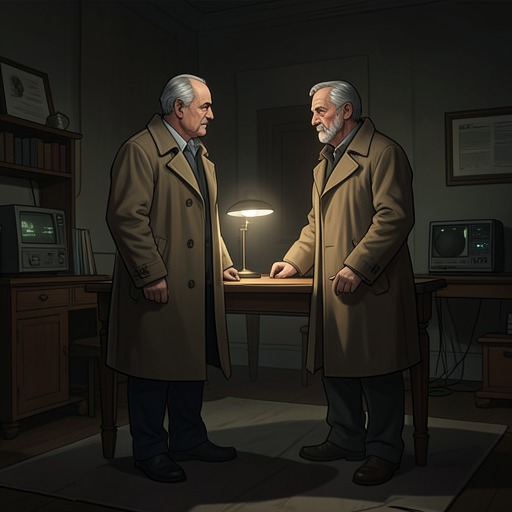
Rostov and Nina Exchange Christmas Gifts
A Gentleman in MoscowCount Alexander Ilyich Rostov and Nina Kulikova exchange Christmas gifts in a scene where affection is expressed through two very different objects: a family heirloom offered openly, and a hotel passkey concealed through a sequence of boxes until midnight. The exchange makes their closeness tangible. It also transforms the familiar rituals of holiday giving—presentation, surprise, and delayed opening—into a quiet declaration of trust.
The setting and the first gift
The exchange takes place at the Piazza on Christmas Eve. After an accordion player begins a jaunty melody reminiscent of an English carol, Count Alexander Ilyich Rostov makes a toast about how, as people age, their social circles tend to contract. He describes finding a fine new friend as extraordinary good fortune, then gives Nina Kulikova a present he says he used when he was her age, meant to tide her over until she travels incognito. The toast makes the gift more than a seasonal courtesy: it acknowledges the friendship that has grown between an older man and a child.
The present is the hexagonal opera glasses of Countess Rostov, the Count’s grandmother. Their mother-of-pearl scopes and delicate brass fittings make the family object visually distinctive, but their significance lies in the personal history attached to them. Nina turns the little binoculars in her hands, then looks around the room through them. In accepting them, she recognizes not only their beauty but the intimacy of being given something that belonged to his family.
Nina tells Count Alexander Ilyich Rostov, “You know me better than anyone,” and promises, “I shall treasure them to my dying day.” Her response confirms that she understands the present as a sign of attentive knowledge, not merely as a valuable possession. Count Alexander Ilyich Rostov, meanwhile, regards her failure to bring him a present as understandable: she is a child, and he does not expect the exchange to be equal or immediately repaid.
Nina’s return gift
When it is time for Nina Kulikova to leave and rejoin her father, she signals for the check. Instead, the captain brings a large yellow box tied with dark green ribbon. Nina gives it to Count Alexander Ilyich Rostov with one condition: he must not open it until the stroke of midnight. The reversal is deliberate and affectionate. The girl who has just received a family heirloom now sets the terms of a surprise, making the older man wait rather than letting the gift be absorbed into the ordinary end of a restaurant visit.
Her present also changes his plans for the evening. He had expected to settle the check, go to the Boyarsky for an herb-encrusted lamb chop, and retire to his study with port until twelve. After Nina leaves, however, he turns his attention to a young couple at a neighboring table. The delayed present remains with him as the evening continues; later, he carries it upstairs under his arm, sets it on his grandmother’s table in the study, and pours himself a glass of port.
The scene does not disclose the contents at the restaurant. That withholding lets the promise of midnight organize the next part of the episode. The gift becomes a small appointment between Nina Kulikova and Count Alexander Ilyich Rostov, observed even after she has gone: he can neither open it early nor forget that it is waiting.
Midnight and the hidden passkey
In the study, Drosselmeyer, the one-eyed cat, turns toward the closet door with its ears upright as the clock’s midnight chimes begin. Count Alexander Ilyich Rostov sets aside his book and port, places Nina’s present in his lap, and listens until the final, twelfth chime before pulling the ribbon. The careful timing honors Nina’s instruction exactly. It also echoes the book’s attention to the clock: the present is not simply opened at night, but at the moment the chimes complete the hour.
The first lid reveals another yellow box with a dark green bow. Each opening produces a smaller version of the same promise: a second box gives way to a third, followed by more layers, until Count Alexander Ilyich Rostov reaches a matchbox-sized container. Inside, strung on a piece of the dark green ribbon, is Nina Kulikova’s hotel passkey. The elaborate nesting stretches a simple reveal into a sequence of patient actions—untying, lifting, and beginning again. The passkey is the practical center of the joke-like packaging, but the delay gives the object a different weight: it arrives as a carefully staged confidence, not as a bare key handed over in passing.
After opening the gift, Count Alexander Ilyich Rostov goes to bed at 12:15 with Dickens. The episode places Nina’s surprise beside his renewed reading of A Christmas Carol, a story whose Christmas scenes he remembers from childhood, including celebrations among Scrooge’s nephew and the Cratchits. Its recollection of Christmas as a time of generosity and human fellowship gives the evening a literary frame without displacing its particular bond: the lasting impression comes from Nina’s attention to what her friend might need and from his willingness to wait for her chosen hour.
Gifts, memory, and trust
The two presents differ in origin and function. Count Alexander Ilyich Rostov gives Nina Kulikova an heirloom whose value comes from family memory; she gives him a passkey, an object connected to the hotel where their friendship has taken shape. One looks backward toward the Countess Rostov and the Count’s own youth, while the other belongs to Nina’s knowledge of the present. Their exchange therefore joins inheritance to practical intimacy without making either gift merely symbolic: Nina can examine and use the opera glasses, and the passkey remains a real hotel key.
The episode also belongs to a wider pattern in Count Alexander Ilyich Rostov’s life of treating hospitality and giving as rituals that establish fellowship. On another occasion, he opens The Ambassador, whose fitted compartments hold fifty-two glasses, selects four at random, and shares brandy with his guests before they toast the Metropol. Later, his farewell to Emile Zhukovsky and Andrey Duras takes the form of letters thanking them for their fellowship, with four gold coins enclosed in each. These instances are not part of the Christmas exchange, but they show how gifts and shared drink repeatedly mark relationships that exceed a simple transaction.
At Christmas, the most striking reciprocity is not an equivalence of price. Nina’s gift requires Count Alexander Ilyich Rostov to honor her timing; his gift gives her something associated with his family and with his younger self. The passkey, concealed until the clock has finished striking, makes trust the final discovery. The scene’s quiet conclusion is not a declaration about friendship but the physical transfer of objects—and the care with which both are given and received.